
Most people who take an ancestry DNA test are chasing a specific kind of answer. Where did my family come from? Am I really as Irish as my grandmother claimed? Do I have a long-lost cousin in Norway? These are the questions that sell DNA kits, and they’re genuinely fascinating ones. But the file that gets generated when a lab processes a cheek swab or saliva sample doesn’t stop at ethnicity. It contains a raw, detailed readout of hundreds of thousands of points across the genome, and only a small slice of that data actually gets used to build an ethnicity estimate or a cousin match.
The rest sits there, mostly untouched, in a downloadable file most people never open. That file is really a snapshot of biological information: how the body processes caffeine, whether certain nutrients are absorbed efficiently, patterns tied to sleep, and dozens of other traits that have nothing to do with ancestry at all. Understanding what’s actually in that data, separate from the pie chart of percentages, changes how a person might think about a test they may have taken years ago purely out of curiosity about their last name.
What’s Actually Encoded in a Raw DNA File
When a consumer DNA test analyzes a saliva or cheek swab sample, it isn’t sequencing an entire genome letter by letter. Instead, it’s reading specific locations known as SNPs, short for single nucleotide polymorphisms. A SNP is simply a spot in DNA where people commonly differ from one another by a single letter. Most consumer tests read somewhere between 600,000 and 700,000 of these spots.
Ancestry companies use a subset of those SNPs, the ones known to vary consistently between populations, to estimate ethnicity and to match people with relatives who share DNA segments. But the full file includes SNPs tied to nearly every category of human biology researchers have studied: metabolism, sleep patterns, taste perception, vitamin processing, and more. The raw file a person downloads from AncestryDNA, 23andMe, MyHeritage, or FamilyTreeDNA typically includes all of it, even though the company’s own app or website may only ever show the ancestry-related pieces.
Health-Related Genetic Markers Hiding in Ancestry Data
Some of the best-understood genetic markers have nothing to do with disease risk in a dramatic sense. They involve things like whether someone can digest lactose comfortably into adulthood, how quickly caffeine clears from the bloodstream, or whether alcohol tends to cause a rapid flush reaction. These are well-established, single-gene or near-single-gene traits, which means the science behind them is relatively clean compared to more complicated conditions.
Other markers relate to inflammation response, how the body handles certain medications, and inherited patterns connected to conditions like high cholesterol or blood clotting tendencies. None of this is visible in a typical ancestry report, not because the data isn’t there, but because ancestry platforms are built and marketed around lineage, not health. The information exists in the file. It’s simply never surfaced.
Traits, Personality Tendencies, and the Gray Areas of Genetics
Beyond clear-cut biological traits, raw DNA files also contain markers that researchers have linked, with varying degrees of confidence, to things like mood regulation, sleep quality, and even certain personality tendencies such as novelty-seeking behavior. It’s worth being direct about the limits here: traits like personality or general risk tolerance are polygenic, meaning they’re influenced by many genes working together, plus environment and life experience. They are not tied to a single gene the way lactose intolerance often is, so any genetic insight into these areas should be read as a tendency or a piece of context, not a prediction or a diagnosis.
That distinction matters. A marker connected to caffeine metabolism can be explained with fairly high confidence. A marker loosely associated with anxiety sensitivity is a much softer signal, one that should be weighed alongside family history, lifestyle, and, when relevant, a conversation with a doctor or genetic counselor rather than treated as a standalone answer.
Why Ancestry Platforms Don’t Show You This Information
It isn’t a conspiracy, it’s a business model. AncestryDNA, 23andMe, and similar companies built their consumer products around family trees, ethnicity breakdowns, and DNA matching with relatives. Their labs, their interfaces, and their marketing are all oriented toward that experience. Health-focused analysis requires a different kind of scientific interpretation, different regulatory considerations, and in many cases a completely separate product line.
Some companies do offer limited health reports as an add-on, but even then, the depth is usually narrow compared to what’s technically present in the file. The raw data itself is agnostic. It doesn’t know or care whether it’s being used for a family tree or a health report. What determines how it gets used is which company, and which software, is doing the interpreting.
Uploading Your Existing Raw DNA File to SelfDecode
Because the raw DNA file downloaded from AncestryDNA, 23andMe, MyHeritage, or FamilyTreeDNA already contains this broader set of markers, it doesn’t need to be recollected from scratch to get a first look at the health side of the data. SelfDecode, a genetics and health analysis platform, allows users to upload that existing file directly. The platform runs it through its own interpretation engine and generates reports on specific topics such as inflammation tendencies, weight-related metabolic patterns, and mood-related pathways, translating the raw SNP data into readable, organized information rather than a spreadsheet of letters and numbers.
For someone who tested with a genealogy company years ago and never thought about the data again, this is essentially unlocking a second layer of the same test, using information that was already collected and already sitting in an account somewhere.
It’s worth noting that an uploaded third-party file offers a limited preview rather than a full analysis. Because the file wasn’t generated using SelfDecode’s own lab process, and because different testing companies use different chip technologies to read DNA, an uploaded file may not cover every marker SelfDecode’s system is built to analyze, and the depth of interpretation is intentionally scaled back compared to what’s available with an in-house sample.
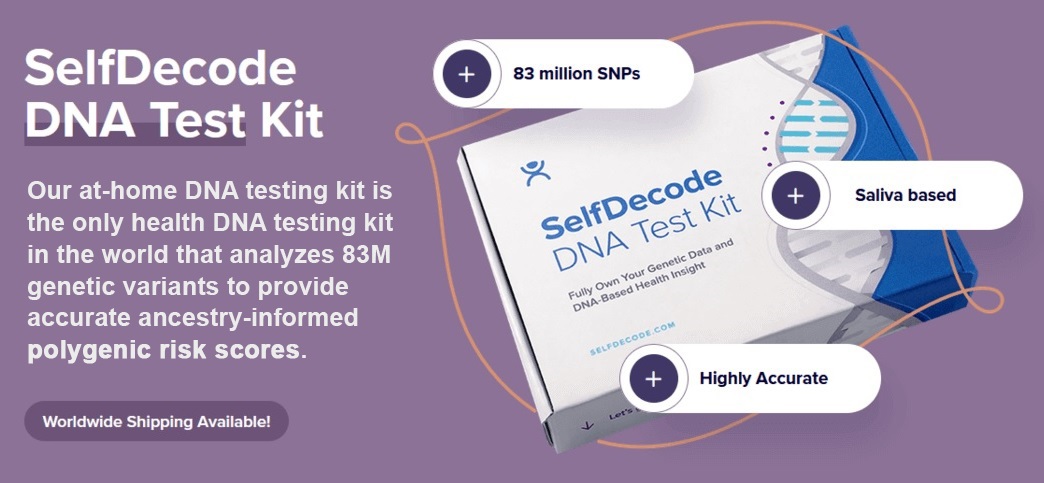
Readers who want the fuller picture, including a more complete panel of health reports and higher confidence in the underlying data quality, might consider the SelfDecode At-Home DNA Test Kit, which runs about $99 and processes the sample through SelfDecode’s own lab from the start, rather than relying on a file originally built for a different purpose.
None of this changes what a person’s ancestry results already showed them. It simply means the same curiosity that led to an ethnicity test can be pointed at a different, equally personal set of questions, using data that was, in a sense, already paid for.
Frequently Asked Questions
Does my raw DNA file really contain more than ancestry information?
Yes. Consumer DNA tests read hundreds of thousands of genetic markers, but ancestry companies typically only use a portion of that data for ethnicity estimates and relative matching. The rest of the markers remain in the downloadable raw file.
Is it safe to download my raw DNA data from an ancestry company?
Most major companies, including AncestryDNA and 23andMe, allow users to download their raw data file through account settings. It’s a standard feature, though users should always store the file securely and be thoughtful about where they upload it afterward.
Can my raw DNA file tell me about disease risk?
It can include markers associated with certain well-studied conditions, but genetic risk information should always be interpreted alongside family history and, when relevant, discussed with a physician or genetic counselor rather than treated as a diagnosis.
Why don’t AncestryDNA or 23andMe show health information by default?
Their products are built primarily around ancestry and family matching. Some offer limited health add-ons, but comprehensive health interpretation typically requires a different kind of platform built specifically for that purpose.
What’s the difference between uploading my file and taking a new test?
Uploading an existing raw DNA file gives a limited preview based on data collected by a different company’s lab. A new test processed through SelfDecode’s own lab typically covers a fuller set of markers and offers more complete, validated results.


